Prep–Year 2 · About 50 minutes
Music, movement and character
A highly led session with quick shifts between movement, rhythm, character play and short ensemble scenes. Clear rules keep the class active and together.
Primary school performance incursions
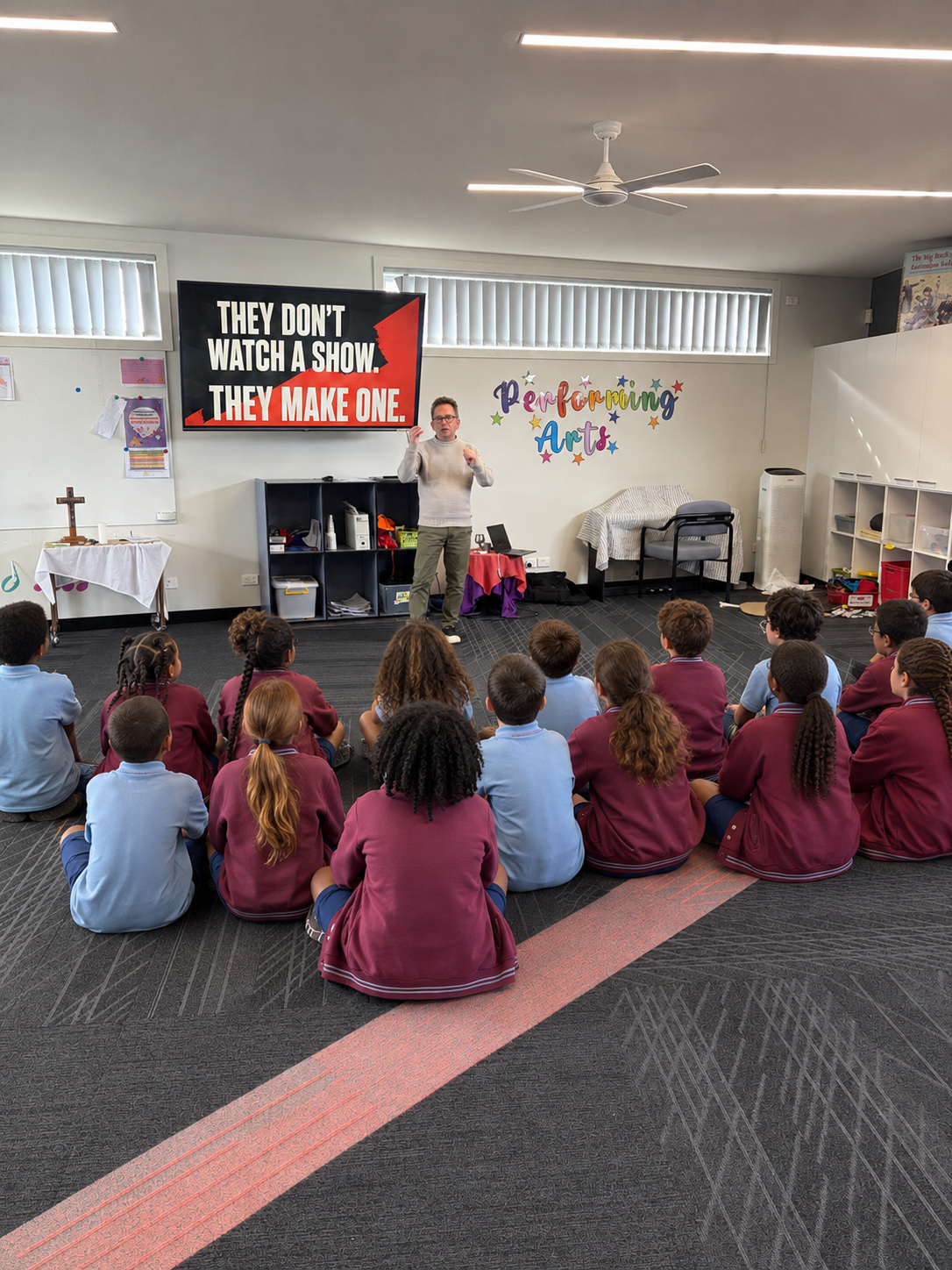
Jon leads students through a compressed professional process: make, rehearse, receive a note, improve, perform.
Flagship · Years 5–6 · 90 minutes
A class works as an ensemble, then in small groups, toward a filmed showcase. Students see what changes when they commit to a clear choice and rehearse it properly.
Focus, spatial awareness and shared timing. The group learns to read one another.
Scripted scenes become playable through intention, eye focus, stillness and what sits beneath the line.
Jon gives direct, usable performance notes. Groups return to the work and make the change visible.
The room becomes the audience. Each group performs a finished piece that the class can watch back.
Prep–Year 2 · About 50 minutes
A highly led session with quick shifts between movement, rhythm, character play and short ensemble scenes. Clear rules keep the class active and together.
Years 3–4 · 60–90 minutes
Students reshape familiar stories using freeze frames, narration, status, comic interruption and simple devising. They finish with a performance an audience can follow.
One practitioner from start to finish
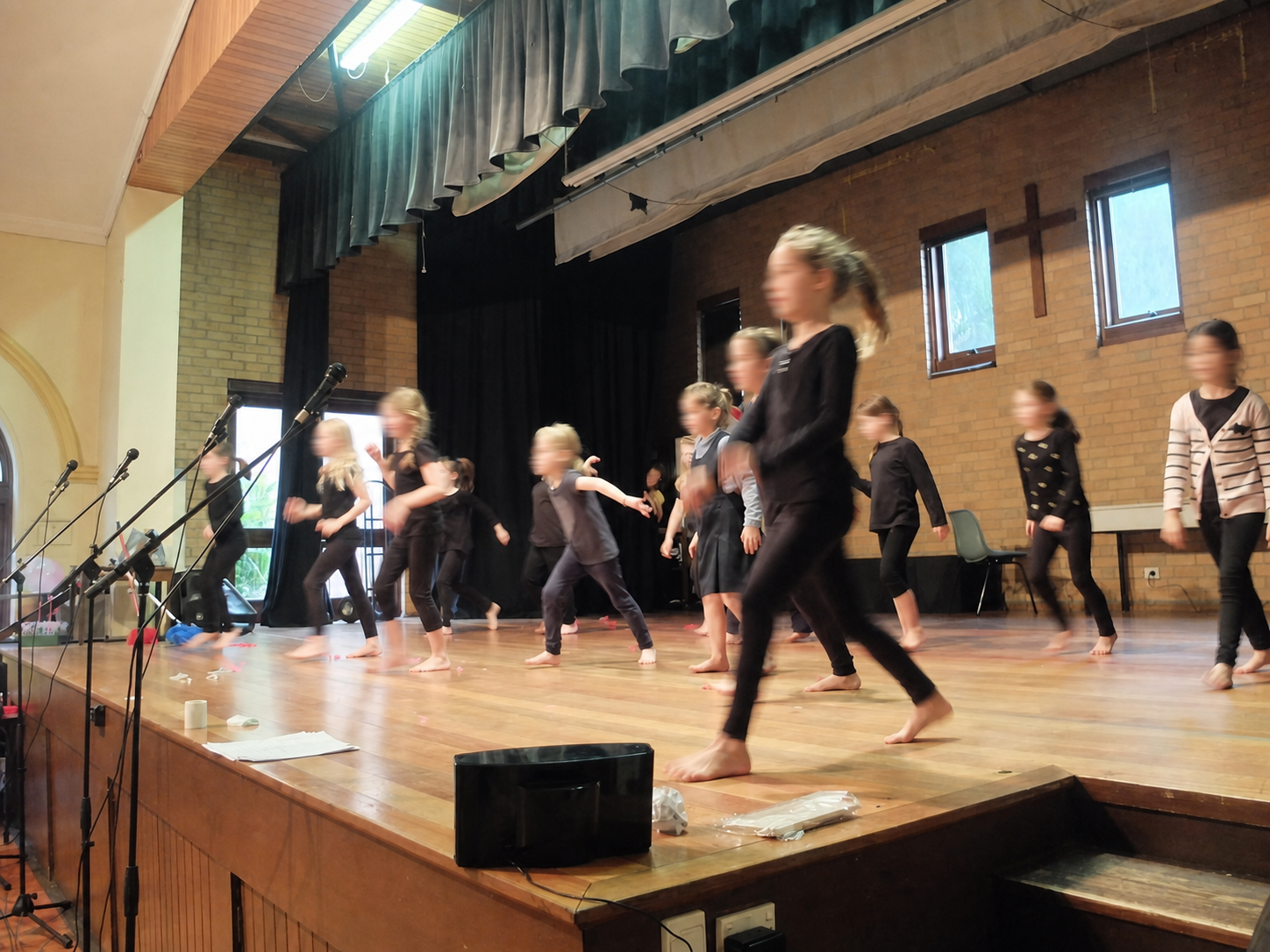
Jon is both a working performer and a VIT-registered Performing Arts teacher. He knows when to push, when to restructure and how to keep every student inside the ensemble.
The classroom teacher stays in the room and sees the rehearsal language in use. A staff session can be added after the student workshops.
Pair the incursion with teacher PD →The Prep–Year 2 workshop is fast-moving and highly interactive. Students move between short drama games and simple comic scenes, learning some of the basic building blocks of performance without getting bogged down in terminology.
We begin with physical activities that get everyone involved straight away.
In exercises such as Walk Like..., students experiment with changing the way they move to suggest different people, animals, moods and situations. We look at how much an audience can understand simply from the way somebody walks, stands or reacts.
Emotions Bus introduces students to showing emotion clearly through their face, body and voice.
Students have to recognise and respond to the choices being made by other performers, while committing to their own character and emotion.
It is deliberately exaggerated and playful, but underneath it they are learning to make an acting choice clear enough for an audience to read.
In The Toyshop, students use imagination and physicality to create toys and characters.
The activity also introduces one of the most important ideas in drama: accepting another person's idea and adding to it.
Rather than stopping a scene by saying "no", students learn to work with what another performer gives them and keep the action moving.
Students then work with short comic scenes such as Invisible Bench and Is It Time Yet?
These simple scripts introduce entrances and exits, repetition, reaction, timing and working together to build a joke.
There is very little dialogue to learn. The success of the scenes comes from listening, watching and committing to what is happening.
The session finishes with students performing some of the short pieces for each other.
At this age, the aim is not a polished production. It is giving children the experience of getting up, joining in, making a clear choice and discovering that performance is something they can do.
Across the session students practise listening, imagination, physical and vocal expression, turn-taking, accepting ideas, comic timing and working as part of a group.
The workshop connects directly with Foundation–Year 2 Drama in the Victorian Curriculum.
It gives students practical experience in dramatic play, creating roles and situations, using voice and movement, presenting short pieces and responding to the work of others.
Very little preparation is required.
A hall, multipurpose room or reasonably open classroom is ideal. Students do not need to prepare anything beforehand, and no costumes or props are required.
All activities and performance material are supplied.
The Years 3–4 workshop builds on the imaginative play students already know and begins to turn it into more deliberate theatre-making.
Students explore how performers can take a simple story or idea and make it interesting for an audience using character, movement, narration, staging and comic choices.
We begin with physical and vocal character work.
Students experiment with changing posture, movement, voice, pace and energy to create characters that are immediately recognisable.
The emphasis is on making strong choices rather than trying to be realistic or getting worried about whether there is a "right" answer.
Students explore different ways of showing a story rather than simply telling it.
We use techniques such as freeze frames, narration and physical tableaux to pick out important moments and make them clear to an audience.
Students begin to think about what an audience needs to see and what can be left out.
Improvisation work develops students' ability to listen and respond to each other.
We look at accepting an idea from another performer, adding something useful to it and keeping a scene moving rather than blocking it.
Students begin to discover that good improvisation is not about being the funniest or quickest person in the group. It is about making the other performers' ideas work as well as your own.
Students are introduced to status in a simple, practical way.
Through posture, voice, space and behaviour they explore who appears to be in charge, who is not, and how that relationship can change.
This is particularly useful when working with larger-than-life characters and familiar stories, where status can immediately make a scene clearer and funnier.
Students work in small groups to turn a familiar story, situation or starting point into a short piece of theatre.
They can use narration, freeze frames, character, movement and comic interruption to shape the scene.
The emphasis is on giving the performance a clear beginning, development and ending, rather than simply improvising until somebody decides to stop.
Groups share their work with the class.
We look at what made the story easy to follow, where the audience's attention went and which physical, vocal or staging choices were particularly effective.
The aim is for students to begin thinking not just as performers, but as theatre-makers: what are we trying to show, and what will make the audience understand it?
The workshop develops character, imagination, improvisation, storytelling, physical and vocal expression, accepting offers, status, ensemble skills and the ability to shape ideas into a short performance.
The workshop supports Years 3–4 Drama learning through character, role, dramatic action, improvisation, devising, voice and movement, performance and reflection.
Very little preparation is required.
A hall, multipurpose room or reasonably open classroom is ideal. Students do not need to prepare material beforehand.
All activities and performance material are supplied.
The Years 5–6 workshop is a practical performance intensive. Students are on their feet from the beginning, working physically, making choices and gradually building towards a short performance.
We start with movement drawn from sport.
Students use actions they already know physically — throwing, catching, swinging, kicking, dodging and so on — and turn them into performance material.
Starting with familiar sporting actions helps students commit fully to the movement rather than producing tentative or decorative movement.
From there we move into grid running and other structured ensemble exercises.
Students have to maintain their own physical commitment while staying aware of space, timing and the rest of the group.
The work develops concentration, coordination, spatial awareness and ensemble discipline.
The next part of the workshop looks at status and how quickly an audience reads it.
Students explore posture, eye contact, stillness, pace, physical distance and vocal tone.
They experiment with changing status and see how relatively small physical or vocal choices can alter the relationship between two characters.
The class is then given a very short, deliberately simple script.
The words stay exactly the same each time and students are not allowed to add or change dialogue.
The challenge is to make the scene interesting through acting choices rather than by rewriting it.
Students work with body language, vocal tone, pace, pause, intention, character relationships and status.
A particularly useful moment occurs when students start wanting to add extra words to explain what their character is really thinking.
Instead of adding those lines, we use them as subtext.
Students then have to communicate those thoughts through performance while keeping the written dialogue unchanged.
Students rehearse the same script in small groups.
Each group works with exactly the same words but makes its own decisions about character, relationship, status and situation.
During rehearsal I move between the groups, giving direction, asking questions and helping students make their physical and vocal choices clearer.
Each group performs its version of the scene for the class.
One of the most useful parts of the workshop is seeing how different the performances become despite every group using exactly the same text.
The comparison makes it very clear that actors create meaning through choices, not just through dialogue.
We finish with a short discussion about what changed during rehearsal, which choices altered the scene and what the audience understood from voice, movement, pause and body language alone.
Across the session we cover ensemble skills, spatial awareness, physical commitment, character, status, vocal expression, intention, subtext, rehearsal and performance.
Students also get repeated practice in making a choice, committing to it, receiving direction and then adjusting the work.
The workshop connects strongly with Years 5–6 Drama, particularly the development of character through voice and movement, scripted drama, dramatic action, rehearsal, performance and reflection.
Very little preparation is required.
A hall, multipurpose room or reasonably open classroom is ideal.
Students do not need costumes, props or prepared material.
All scripts and workshop material are supplied.
Regional travel and accommodation may be quoted separately where required.
For productions, multi-day visits, teacher support or programs involving several year levels, we can build a timetable around the school's needs.
These programs are quoted separately depending on the scope.
Build the right school day
He will recommend the strongest format and keep the day realistic.